


By Darby Kendall
Jonah Sacha, Ph.D., a professor of pathobiology and immunology in the OHSU VGTI-Vaccine and Gene Therapy Institute, believes we’re going to cure HIV in our lifetimes, and OHSU will play a major role in that.
At a recent talk he gave, Sacha discussed how OHSU and its partners can translate scientific victories into scalable
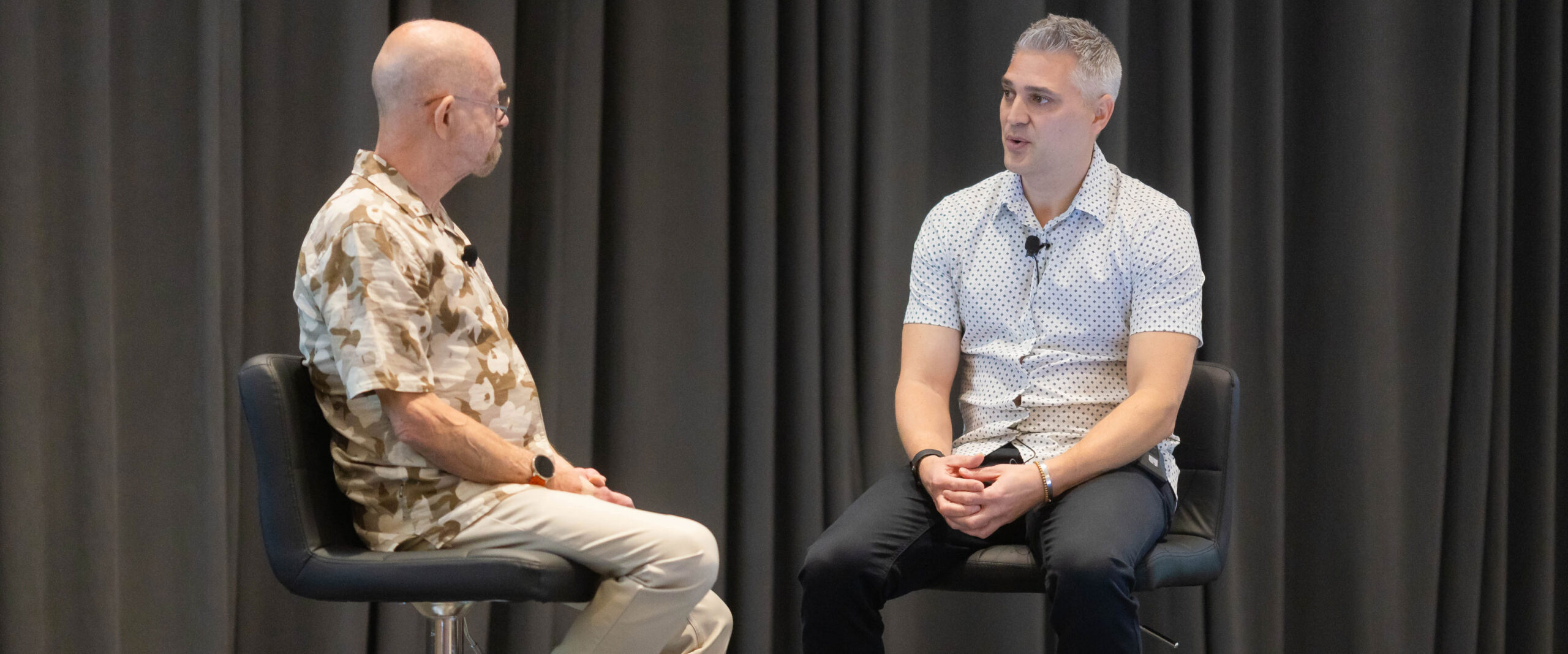
treatments and prevention strategies that move us closer to eradicating HIV worldwide. Sacha also spoke in conversation with Paul Edmonds, the oldest individual to achieve remission from both HIV and leukemia. Here are the highlights from Sacha’s speech and conversation with Edmonds.
Transcript
Something miraculous has happened recently. We know through a handful of cases, and by handful I really mean you can count on the fingers in one hand, of individuals that have been cured of HIV, and this cure came from a bone marrow transplant to treat leukemia.
Dr. Jonah Sacha, a professor of pathobiology and immunology, believes we’re going to cure HIV in our lifetimes, and OHSU will play a major role in that. At a recent talk he gave, Dr. Sacha discussed how OHSU and its partners can translate scientific victories into scalable treatments and prevention strategies that move us closer to eradicating HIV worldwide. Here are the highlights from his talk.
Sacha: It started with the first person ever cured of HIV, whose name was Timothy Ray Brown, also known as the Berlin Patient. Now Timothy had connections to the Pacific Northwest because he grew up in the Pacific Northwest, but he was living in Berlin, Germany at the time of his treatment, and that’s why he’s called the Berlin patient. And you see, Timothy had really bad luck. He was diagnosed with both HIV and leukemia, and he needed a bone marrow transplant to treat his leukemia. But his physicians in Germany tried to do something very clever. They decided they were going to, for the first time, attempt to cure someone of both leukemia and HIV, and they were going to do this by finding a very special type of bone marrow donor.
When HIV infects a cell, it does so by using a protein on the cell surface called CCR5. And CCR5, think of it like a lock on the surface of the cell, and HIV has a key for this lock. It comes along and it puts its key in the lock and it unlocks CCR5 and opens the door to enter the cell and infect it. For reasons that we don’t understand, about 1% of individuals living in Northern Europe simply don’t have CCR5. So there’s no lock on the surface. HIV’s key doesn’t work. It can’t get into cells, they can’t be infected, and people who lack CCR5 are naturally immune to HIV.
So, Timothy’s doctors found a bone marrow donor who was both tissue matched and also did not have CCR5, and it worked. People thought this was crazy, but it worked. It actually cured Timothy. He was the first person to ever be cured of HIV, and he remained HIV-free until his untimely death in 2020.
Right now, there are three individuals in the world who have been cured of HIV that have released their identity, and all of them were cured by receiving a bone marrow transplant from someone lacking CCR5. So, we at OHSU realized that for the first time we were at this inflection point, that there were actually multiple individuals cured of HIV that had released their identity that we could bring together and study. I reached out to these individuals and said, “We’d like you to work alongside of us so we can define how you were cured, so we can take your rare case of cure and make it applicable to anyone on the planet through a single shot in the arm, no matter where they’re living.” And they all agreed.
And so, we at OHSU right now have established the world’s only HIV cure consortium to bring together individuals that have been cured of HIV, so that we can work with them to find how they were cured, reverse engineer it, and make a cure that is broadly applicable across the entire world. And today we’re fortunate to be joined by one of these individuals. Paul Edmonds, the City of Hope patient, is here today. Thanks for coming, Paul.
Edmonds: My pleasure.
Sacha: So I think it would be great if you could share with us your journey through diagnosis and cure. And so you were the only individual that received a clinical diagnosis of AIDS that was then cured. Can you bring us back to the moment when you received your HIV diagnosis and what that felt like?
Edmonds: Yes. Well, it was in 1988 when I was diagnosed with HIV and AIDS. It was a time of great uncertainty. Most people are only living a couple of years after the diagnosis, so you know, I really didn’t know if there was going to be much of a future or not. However, I’ve got to say that it set me on a journey that I never could have imagined.
Sacha: Do you recall the moment that you first learned of Timothy’s cure? Can you tell us about that?
Edmonds: Yeah, I do. I was sitting in my kitchen in Northern California, and the morning news came on, and they announced that the Berlin patient was Timothy Ray Brown, and he had been cured of AIDS. It was the first time that I ever had hope that there was a possibility for a cure. I still hold on to that hope.
Sacha: You know, you were there at the beginning of the epidemic. Can you tell us what it would mean to you to be there at the end and see a cure that’s available for everyone?
Edmonds: It would close the circle that started for me over 40 years ago when HIV was a death sentence. I think it would mean that science and compassion and human determination had overcome fear and stigma.
Sacha: That’s beautiful. Thank you, Paul.
So I hope after hearing from Paul, you can begin to share in the excitement that I have. This really is a unique resource that is only at OHSU right now. It’s incredible.
Discovery
Discovery
Discovery